Copyright (C) 2005-2006 Windward Mark Interactive, LLC. All Rights Reserved.

WindLight's core strength is its speed. Written in high-level shaders and optimized for Commercial Off-The-Shelf (COTS) hardware, WindLight can be used on current systems while ensuring required framerates.
WindLight offers two major advantages:
Classic atmospheric models are woefully slow on modern hardware. At adequate rendering settings, framerates under 30 fps are common on simple scenes, making these methods unusable in real simulators. The cause of this slowdown is inefficient approximation throughout the shader pipeline. WindLight's algorithms, however, are highly optimized for real-world performance in high-polygon scenes.
The following benchmarks are taken with a COTS PC, running with a single GPU:
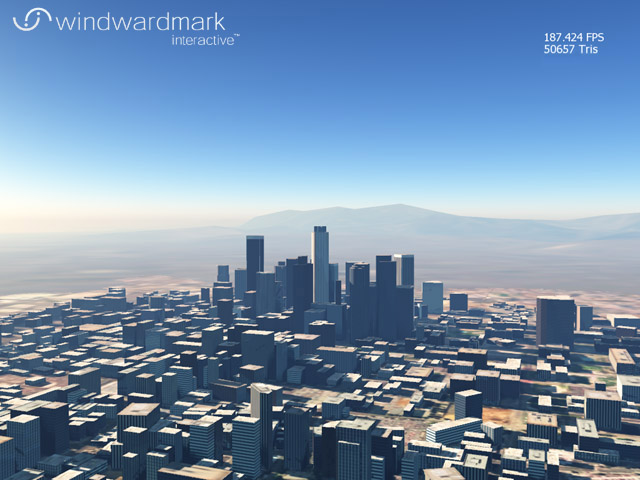
Scene 1: 50K+ polygon city model and terrain, rendered with 24-bit textures and lightmaps. Resolution: 1024x768x32 with 2x AA. Framerate: 187 FPS
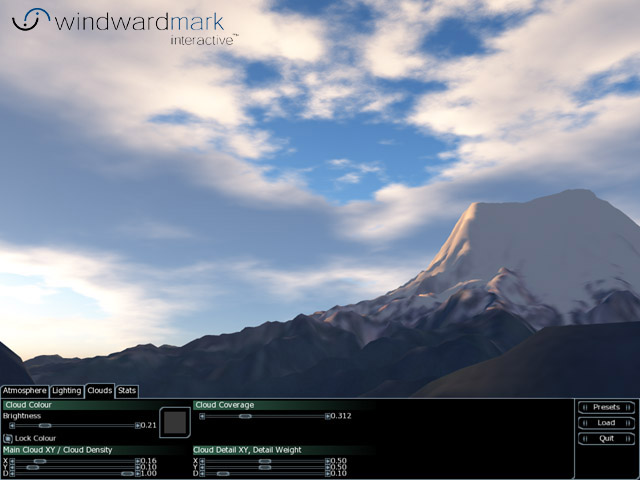
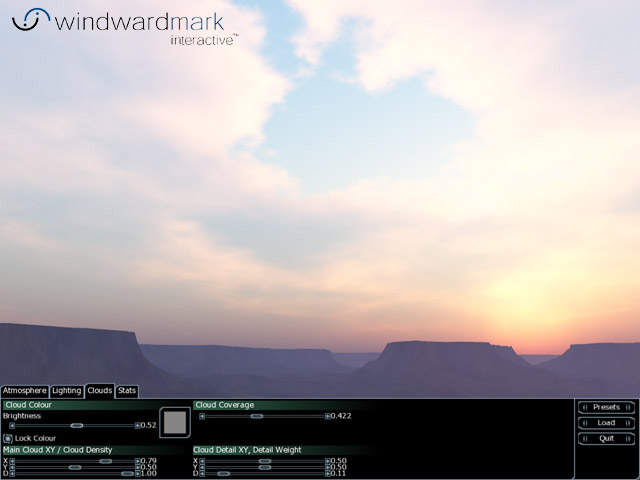
Scene 2: 150K+ polygon terrain, normal-mapped and textured. Interactive clouds, cloud shadows on terrain, and terrain self-shadowing are all being rendered. Resolution: 1024x768x32 with 2x AA. Framerate: 115 FPS
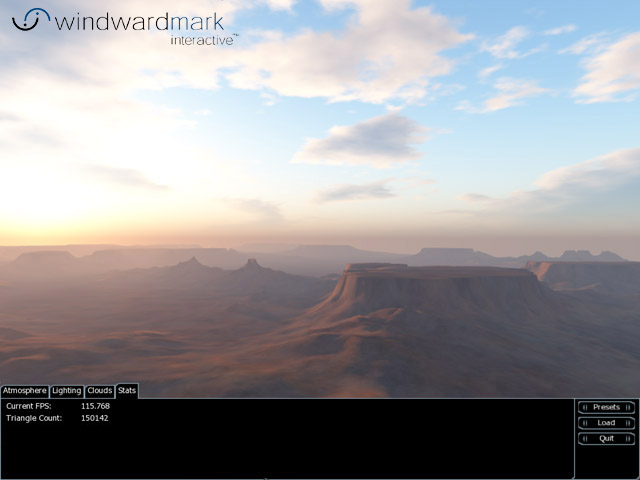
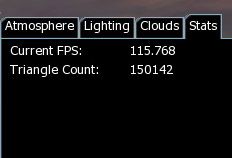
Scene 3: 210K+ polygon terrain with water, normal-mapped and textured. In addition to cloud shadows and terrain self-shadowing, double-rendering of the scene is occuring for water reflection. Resolution: 1024x768x32 with 2x AA. Framerate: 73 FPS
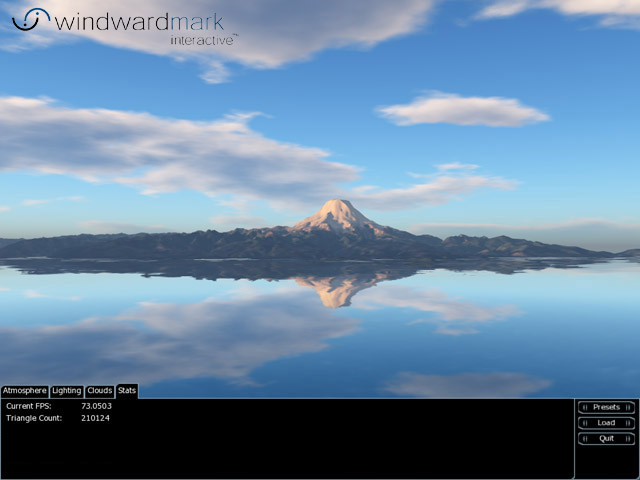
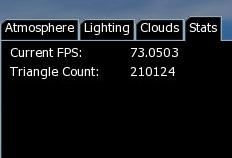
Other atmospheric lighting methods suffer from poor image quality and limited usability. The reason for this lies in the simplifications that these systems have to make to speed up their computations. Scenes are usually kept to stark skys with simple terrain and no cloud cover. Convincing sun positions exist only in a very narrow range near the horizon. To maintain adequate speeds, these systems cannot model the complex layers of physical interaction that occur. As a result, they are very limited in the range of scenes that they can represent.
WindLight doesn't suffer from this quality/speed problem. It is based on entirely different models, and uses patent-pending algorithms to keep its framerates extremely high at all times. WindLight was written from the ground up to be used in real simulators, on all objects, in all conditions, while always maintaining its photographic fidelity and speed.